
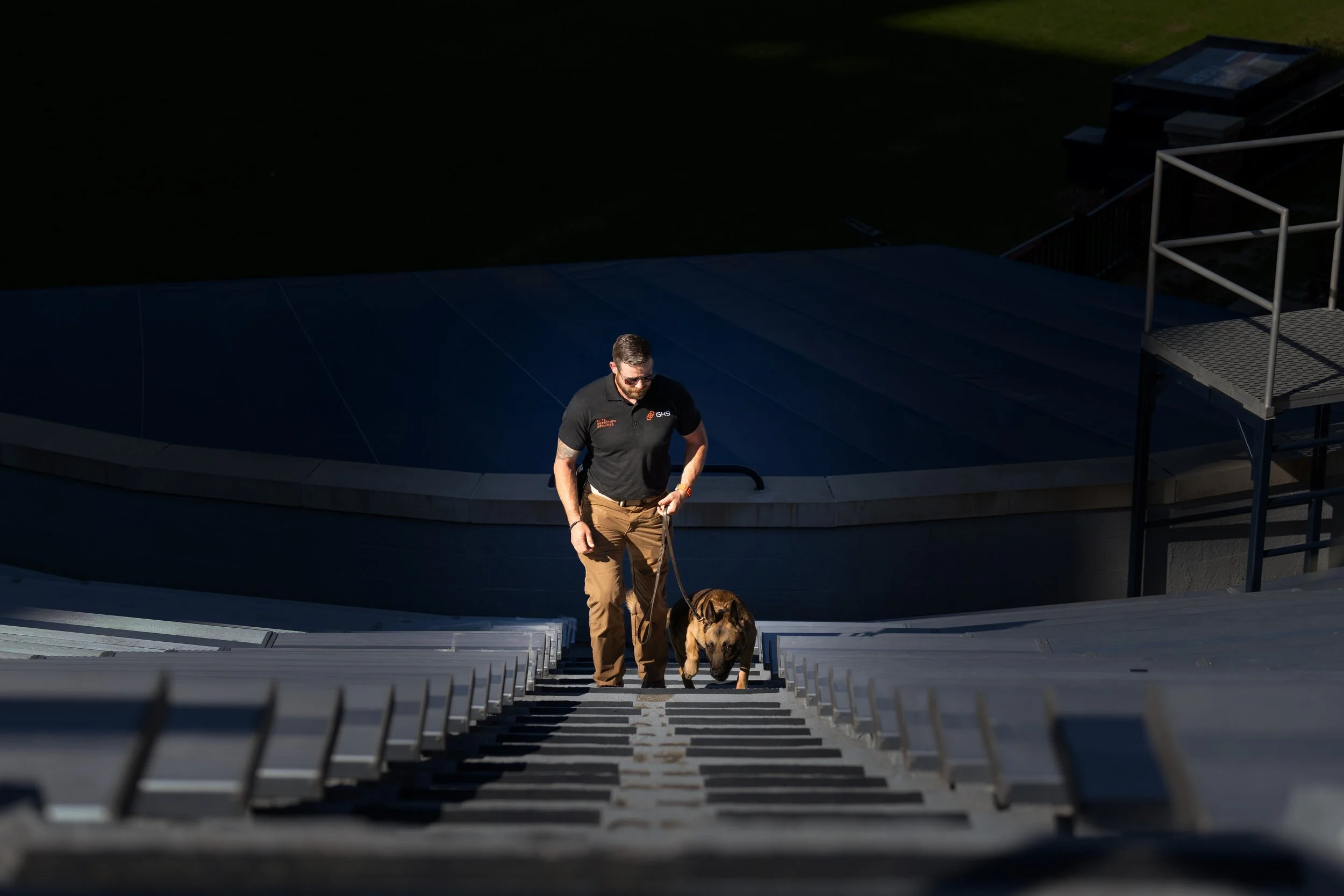
What Makes a Detection Team Operationally Fluent?
In the high-stakes environments of aviation security, critical infrastructure, and cargo screening, operational fluency is not optional; it is essential. At Global K9 (GK9), operational fluency is the defining standard that separates merely qualified detection teams from elite ones. But what does it truly mean to be operationally fluent? It goes far beyond a canine’s ability to detect odors or a handler’s ability to interpret signals. It is a holistic capability, a harmony of tactical readiness, behavioral consistency, and mission-driven execution.
This article breaks down the core attributes that make a detection team operationally fluent and explores why these standards are indispensable to the success of high-consequence operations.
1. Canine Proficiency: Beyond Basic Detection
At the heart of any detection team is the working canine. A team cannot be operationally fluent without a dog that performs with consistent precision under dynamic conditions. Operational fluency begins with:
Odor Recognition Accuracy: The canine must demonstrate reliable performance across a variety of target odors including explosives, narcotics, or contraband without false positives or delayed responses.
Environmental Resilience: The canine must perform in diverse, unpredictable environments such as crowded airports, busy seaports, and high-noise industrial sites.
Behavioral Stability: An operationally fluent canine remains focused amid distractions, showing consistent response thresholds regardless of stress, fatigue, or handler presence.
2. Handler Expertise: More Than a Leash Holder
While the canine may be the sensor, the handler is the interpreter, tactician, and leader. A fluent handler does more than conduct searches, they manage the environment, understand the mission, and adapt in real time.
Key attributes of a fluent handler include:
Threat-Based Decision Making: A handler must be able to assess operational risk, adjust search patterns, and escalate concerns based on situational context.
Proficiency in Canine Behavior Analysis: Handlers must accurately read their canine's body language, distinguish between productive changes and false alerts, and respond accordingly.
Mission Alignment and Discipline: From time-on-target metrics to chain-of-custody protocols, the handler is accountable for executing procedures that uphold both detection effectiveness and regulatory compliance.
Operational fluency also demands that the handler be as well-versed in safety protocols, site-specific SOPs, and client communication as they are in leash handling. The modern detection handler is part technician, part operator, and part ambassador.
3. Team Cohesion: Canine and Handler as a Single Operational Unit
It is not enough to have a highly trained dog and a skilled handler. Operational fluency is the product of team synergy, an instinctive coordination built through rigorous training, repetition, and mutual trust. Signs of a cohesive detection team include:
Non-Verbal Communication: The handler and dog operate with minimal commands, relying on subtle cues and established rhythm.
Fluid Transitions: Shifting from one operational task to another—such as from perimeter patrol to checkpoint screening—should occur seamlessly, with little disruption to tempo or focus.
Mutual Confidence: The handler trusts the canine’s alerts, and the canine remains focused because it trusts the handler’s command and environment management.
This cohesion is what allows detection teams to move confidently through variable terrain, congested staging areas, and time-sensitive scenarios.
4. Operational Readiness: The Hallmark of Professionalism
Operational fluency also means always being ready to deploy. Readiness includes physical, logistical, and psychological preparation to respond immediately and effectively.
Equipment Accountability: The team has full control over detection kits, leashes, PPE, documentation tools, and communication devices—ensuring no delays or breakdowns during mission execution.
Physical and Mental Endurance: Both dog and handler must be conditioned for sustained performance. This includes acclimatization to weather, fatigue mitigation strategies, and readiness for extended duty cycles.
Redundancy Planning: Fluent teams are trained in contingencies—what happens if a canine is injured, a handler is unavailable, or a location is compromised? The team’s operational posture includes backup plans and cross-team coordination capabilities.
Readiness is not an occasional standard—it’s a permanent state of being. A detection team must be as sharp at 0200 on a tarmac as they are at 0900 during a demonstration run.
5. Documentation and Data Discipline
In regulated environments, performance must be measurable and auditable. Operational fluency requires strict adherence to documentation protocols and data accuracy.
Search Logs and Alert Documentation: Every search must be logged with fidelity—location, duration, alert outcomes, and handler observations.
Training Records: Monthly, quarterly, and annual training requirements must be met and documented to regulatory standards (TSA, DHS, FAA, etc.).
After-Action Reports and QA/QC Inputs: Fluent teams contribute to the constant improvement of operational standards through detailed post-mission reviews and performance feedback.
The ability to prove operational validity is as critical as executing the mission itself. Fluent teams treat documentation as a core mission function, not a post-hoc task.
6. Client Integration and Situational Awareness
An operationally fluent team integrates smoothly into the client environment, causing minimal disruption or friction. This involves:
Professional Demeanor: Teams maintain professional appearance, communication, and conduct at all times, representing both GK9PG and the client.
Understanding Client Priorities: The team aligns their efforts with client concerns, whether it's throughput, discretion, brand reputation, or regulatory compliance.
Situational Fluency: Whether at an airport, seaport, stadium, or facility, the team understands site-specific dynamics—entrances, vulnerabilities, VIP zones, or cargo flow—and adapts accordingly.
Client trust is built not just through detection accuracy, but by consistently showing that GK9 teams elevate the client’s security posture with minimal operational friction.
7. Continuous Training and Improvement
The environment is always evolving, and so must the detection team. Operational fluency is not a permanent achievement; it is a continuous pursuit.
Scenario-Based Refreshers: Teams undergo advanced training scenarios that reflect real-world complexity, including decoys, concealment challenges, and stress inoculation.
Technology Integration: Fluent teams adapt to new tools, such as body-worn cameras, biometric verifications, or smart reporting platforms—without performance degradation.
Performance Metrics and Coaching: Handlers receive regular performance reviews and feedback, not just to meet standards but to push them higher.
At GK9, we invest in sustained excellence because we know the mission never sleeps.
Conclusion: The GK9 Standard
Operational fluency is more than a checklist. It is a mindset. It is a demand for excellence across every operational variable—detection capability, handler judgment, team chemistry, client rapport, and tactical readiness. At GK9, we don’t just deploy teams—we deploy force multipliers that stand ready for any mission, under any condition, at any hour.
Because when the stakes are high, there is no room for "good enough." There is only room for fluent, proven, trusted performance.